
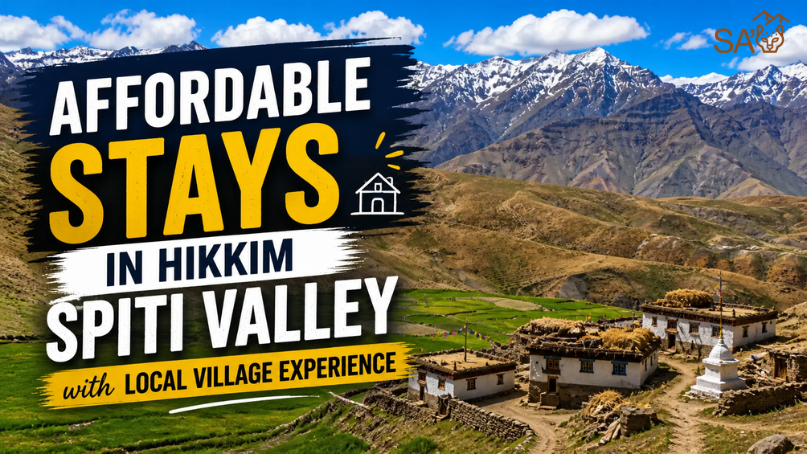
If you’ve ever dreamed of waking up at 14,400 feet above sea level, surrounded by snow-capped Himalayan peaks, breathing crisp mountain air, and sharing a meal with a family whose ancestors have called these barren yet breathtaking lands home for centuries — then Hikkim in Spiti Valley is your destination. Nestled deep in the cold desert of Himachal Pradesh, Hikkim is not just a dot on the map. It is the village that houses the world’s highest post office and, more importantly, one of the most authentic Himalayan living experiences you can find anywhere in India.
And the best part? You don’t need to burn a hole in your pocket to experience it. Affordable stays in Hikkim Spiti Valley are not only possible — they are, in fact, the most rewarding way to explore this remote Himalayan gem.
Why Hikkim, Spiti Valley?
Spiti Valley, often called “Little Tibet,” is a high-altitude cold desert that straddles the borders of India and Tibet. While popular stops like Kaza and Key Monastery draw most of the tourist crowd, Hikkim remains beautifully off the beaten path. Situated just 17 km from Kaza, this tiny village of barely 100 households offers travellers something that no luxury resort can replicate — genuine Himalayan village life.
Here, you will find terraced barley fields clinging to steep hillsides, prayer flags fluttering in the wind, and locals dressed in traditional Spitian attire going about their daily lives. The slow rhythm of Hikkim is contagious. Within hours of arriving, you will find yourself sitting cross-legged on a cushioned floor, sipping butter tea and listening to an elder narrate stories of the valley’s Buddhist heritage.
What Makes an Affordable Stay in Hikkim Special?
When travellers search for affordable stays in Hikkim Spiti Valley, they often imagine compromising on comfort. The reality is entirely different. The homestays and budget guesthouses in Hikkim are family-run, clean, and filled with warmth that no five-star hotel can manufacture.
1. Homestays — The Heart of Hikkim’s Hospitality
The majority of accommodation options in Hikkim are homestays, where local Spitian families open their traditional mud-brick homes to travellers. These homes are built using centuries-old construction techniques — thick mud walls that insulate against the bitter cold, wooden beams carved with intricate Buddhist motifs, and flat rooftops that double as drying grounds for apricots and vegetables in summer.
Staying in one of these homes means you are not just a tourist passing through. You become a temporary part of the family. Hosts prepare home-cooked meals using locally grown produce — organic barley, fresh vegetables from the kitchen garden, and wild herbs foraged from the surrounding hills. Typical meals include Thukpa (Tibetan noodle soup), Tsampa (roasted barley flour), Momos, and Chhang (local barley beer), all served with generous helpings of warmth.
Most homestays charge between ₹600 to ₹1,500 per night including meals, making them genuinely affordable stays in Hikkim Spiti Valley without compromising the richness of the experience.
2. Guesthouses and Budget Dormitories
For solo backpackers and budget travellers, Hikkim also offers simple guesthouses and dormitory-style accommodation. These are ideal if you want to meet fellow travellers while still keeping your costs to a minimum. Dormitory beds can be found for as low as ₹400–₹700 per night, and most guesthouses offer basic but clean amenities — blankets, shared washrooms with hot water (available at designated hours), and a common dining area.
The Local Village Experience — What to Expect
Beyond the bed and the meal, what truly defines affordable stays in Hikkim Spiti Valley is the access they grant you to authentic village life. Here is what a typical day in Hikkim might look like:
Morning: Rise early to watch the sunrise paint the barren mountains in hues of gold and amber. Your host family will already be awake, preparing butter tea. Join them on the rooftop for the first cup of the day and watch the village slowly come to life.
Mid-Morning: Walk to the Hikkim Post Office — the world’s highest at 14,567 feet — and send a postcard to someone you love. The postmaster, often a local who has spent decades at this altitude, is a fascinating conversationalist. From there, explore the surrounding fields and say hello to farmers tending their barley crops.
Afternoon: Visit the nearby Komik village (the world’s highest inhabited village accessible by motorable road) or trek toward the Hikkim gompa, a small Buddhist monastery perched dramatically on a clifftop. If you’re staying long enough, your host can arrange a guided walk through ancient footpaths connecting neighbouring hamlets.
Evening: Return to your homestay for a communal dinner. This is when the magic truly happens. Stories are exchanged across the dinner table, children show off their school projects, and if you’re lucky, someone will bring out a traditional musical instrument and the evening will drift into music.
Activities You Can Enjoy During Your Stay
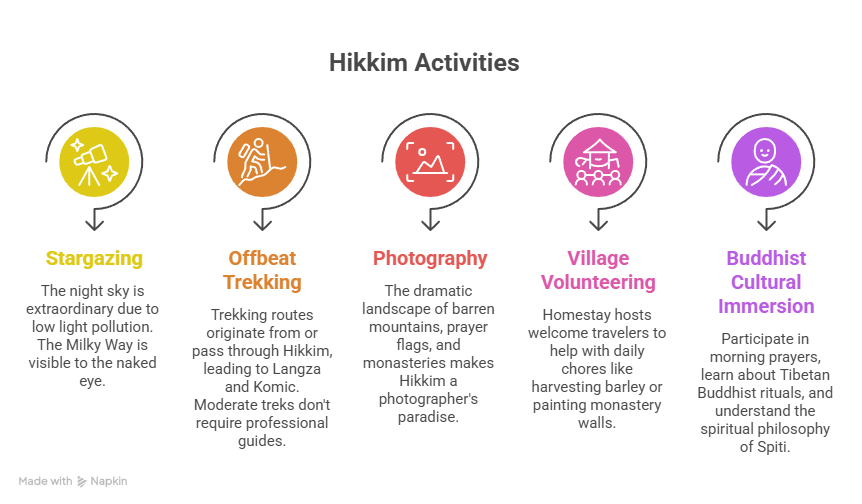
Hikkim is not just a place to sleep — it’s a place to experience. Here are some of the activities that pair perfectly with affordable stays in Hikkim Spiti Valley:
- Stargazing: At this altitude, far from any light pollution, the night sky in Hikkim is absolutely extraordinary. The Milky Way is visible to the naked eye, and your host can often point out constellations that have guided Himalayan shepherds for generations.
- Offbeat Trekking: Several trekking routes originate from or pass through Hikkim, including trails leading to Langza and Komic. These are moderate treks that don’t require professional guides for most sections.
- Photography: The dramatic landscape of barren mountains, vibrant prayer flags, and ancient monasteries makes Hikkim a paradise for photographers.
- Village Volunteering: Some homestay hosts welcome travellers who wish to spend time helping with daily chores — from harvesting barley to helping paint the monastery walls during seasonal maintenance.
- Buddhist Cultural Immersion: Participate in morning prayers at the local gompa, learn about Tibetan Buddhist rituals, and understand the spiritual philosophy that shapes every aspect of life in Spiti.
Best Time to Visit Hikkim
Hikkim is accessible by road primarily between June and October, when the passes leading into Spiti Valley are open. July and August are peak months and bring the most visitors, though even then the crowds are minimal compared to mainstream tourist destinations. September and early October are particularly beautiful — the harvest season transforms the landscape, and the golden barley fields against the blue Himalayan sky are a sight to behold.
Winter travel (November to May) is possible but only for seasoned adventurers with proper gear, as temperatures can plummet to -30°C and roads remain largely snow-bound.
How to Reach Hikkim
Getting to Hikkim requires effort, but that is part of its charm. The most common routes are:
- Via Manali – Kaza (Kunzum Pass route): Open roughly June to October. The journey from Manali to Kaza takes around 10–12 hours by road. From Kaza, Hikkim is a further 17 km.
- Via Shimla – Kaza (National Highway 505): A longer but more scenic route through Kinnaur, accessible for a slightly longer window. From Kaza, local taxis or shared jeeps run to Hikkim.
Shared jeeps from Kaza to Hikkim cost around ₹100–₹150 per person, making even the final leg of the journey budget-friendly.
Practical Tips for Budget Travellers
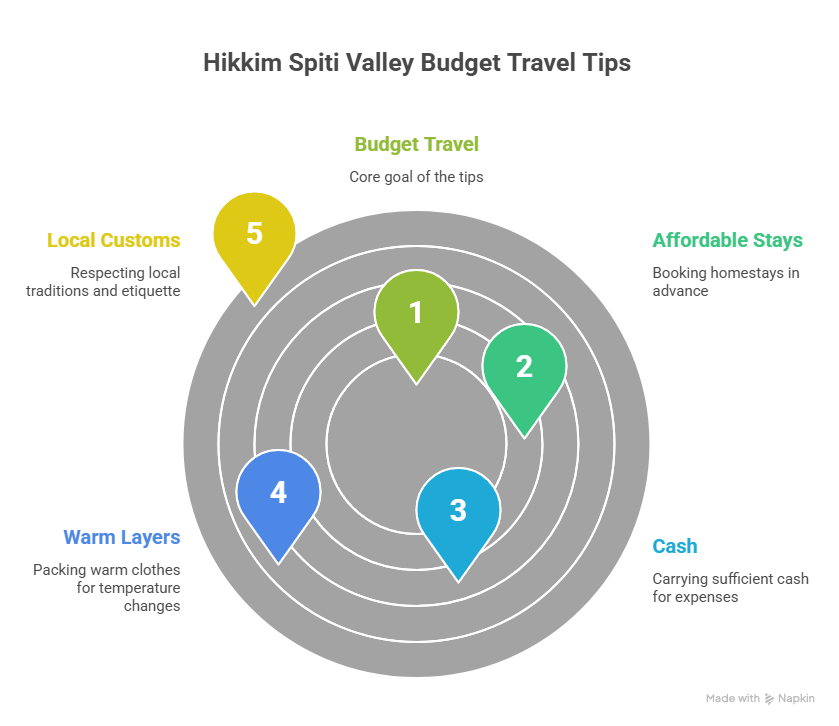
Planning affordable stays in Hikkim Spiti Valley requires a little preparation:
- Book your homestay in advance during peak season (July–September), as options are limited and fill up quickly.
- Carry cash — ATMs in Spiti are unreliable and Hikkim has none. Withdraw sufficient cash in Kaza or Reckong Peo before heading further into the valley.
- Pack warm layers regardless of the season. Temperatures can drop sharply after sunset even in summer.
- Respect local customs — dress modestly, ask before photographing people, and remove your shoes before entering a home or monastery.
- Acclimatize properly — if coming from lower altitudes, spend at least a day in Kaza before proceeding to Hikkim to avoid altitude sickness.
- Carry a reusable water bottle and refill from natural springs — this keeps your costs down and reduces plastic waste in this fragile ecosystem.
Why Hikkim Deserves a Place on Every Traveller’s Bucket List
In an age of curated Instagram aesthetics and manufactured travel experiences, Hikkim offers something increasingly rare — authenticity. The people are genuine, the landscape is raw, and the experience of affordable stays in Hikkim Spiti Valley leaves you with memories that no resort brochure could promise.
Whether you are a solo backpacker on a shoestring budget, a couple seeking a remote romantic escape, or a family wanting to show children how life thrives against all odds at the roof of the world — Hikkim has something deeply moving to offer.
The world’s highest post office isn’t Hikkim’s most extraordinary feature. Its people are.
Conclusion
If you are looking for affordable stays in Hikkim Spiti Valley that go beyond a bed and a meal — stays that offer you a genuine window into one of the world’s most extraordinary mountain cultures — then Hikkim is where your journey belongs. And when the memories of those starlit nights, butter tea mornings, and prayer flag evenings stay with you long after you’ve returned to the plains, you’ll understand why travellers keep coming back to Spiti.
At Sau Cottage, we believe that travel is most meaningful when it connects you to a place and its people — the same philosophy that drives our love for authentic, community-rooted experiences. Explore more about mountain stays, travel guides, and hospitality stories at saucottagesanddorms.com.